Founding of the Brotherhood of the Condemned
Last and First MenThe founding of the Brotherhood of the Condemned is a response to a double bind: the Last Men know their world is failing, yet believe they must remain alive long enough to scatter the seed of humanity. The brotherhood gives that obligation a human form. Its members cannot recover the confidence of their former civilization, but they can console the distressed, strengthen one another, and try to preserve the spirit until their task is complete.
A duty inherited from a failing world
The Last Men describe their society as having fallen from a height that once made it the flower of a galaxy. Now its political and economic order is breaking down, and the community is declining from what it understands as a more enlightened state. The attempt to preserve humanity’s future therefore begins not in confidence, but amid disorder and diminishing capacity.
The Scattering of the Seed has nevertheless become, for every one of them, the supreme religious duty and the last office of humanity. They believe they have stayed beyond their proper time for this purpose. The obligation survives even as they watch themselves decline toward a condition from which humanity has only rarely escaped. It is not presented as a guarantee of survival: even if the seed takes root, life elsewhere will eventually end, whether through fire or the advance of frost. At best, their work may make death’s eventual harvest larger.
That bleak calculation makes the duty harder, not easier, to explain. The Last Men can find no rational defense for their labor except that they must carry out a purpose conceived in an earlier and supposedly more enlightened state. Yet they are no longer sure that their former selves truly possessed superior wisdom. They remember the former glory only with wonder, incomprehension, and misgiving; the shared vision that once seemed to guide them has almost vanished from memory.
Formation and vows
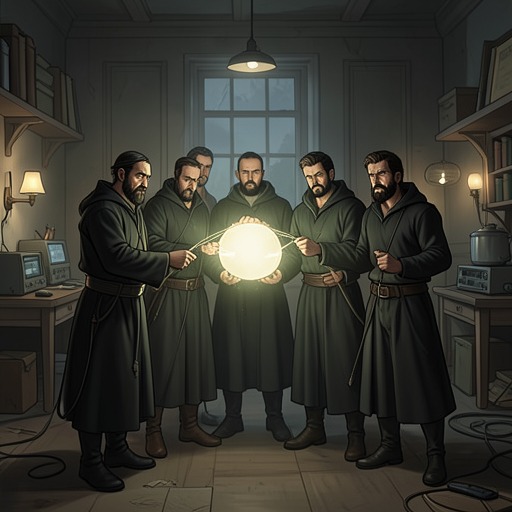
Against this uncertainty, those who have not yet sunk too far form themselves into a brotherhood for mutual strengthening. The act is modest in scale but exact in purpose: the members mean to maintain the true human spirit a little longer, until the seed has been well sown and death becomes permissible. Their fellowship does not remove the doom or restore the lost vision. It creates a way to remain answerable to one another while pursuing the task that outlasts their confidence in it.
The brotherhood’s commitments are both practical and spiritual. Its members vow fidelity to one another, to their common undertaking, and to the vision that is no longer revealed to them. They also undertake to comfort all distressed people who are not yet permitted death, to continue the dissemination, and to keep the spirit bright until the end. The order of these responsibilities matters: the great future-directed work depends on care for people suffering in the present, while the mutual vows help preserve the resolve needed to continue that work.
The founding thus differs from an uncomplicated celebration of a common faith. The Last Men acknowledge that they repeatedly fail in their duty, even while recognizing it as humanity’s final responsibility. Their association is not proof that doubt has been overcome. Rather, it is an answer to weakness: people who cannot sustain the undertaking alone bind themselves to sustain it together.
Meetings and mutual support
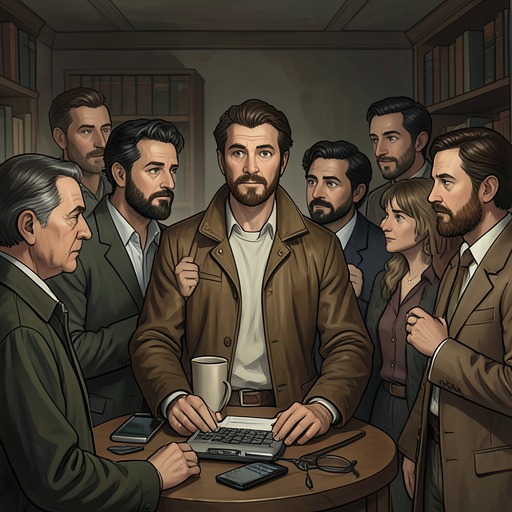
The brotherhood meets in groups that may be small or large, using one another’s presence to gather courage. These occasions do not reliably produce reassurance. Sometimes the members sit in silence, searching for consolation and strength; sometimes speech passes among them, but brings only a brief light and little warmth. The meetings register the limits of fellowship as well as its necessity. The members cannot make their predicament intelligible or undo it simply by assembling, but even a failed attempt at comfort is part of their shared effort to endure.
The contrast with earlier religious orders of human history sharpens the character of this fellowship. In a prior age, scientific achievement had acquired the force of dogma, and the worship of activity could govern life from childhood onward. Other societies had also made faith an instrument for reshaping social order, sometimes by persecuting those who challenged established forms. The Brotherhood of the Condemned, by contrast, is described through mutual aid, fidelity, consolation, and the difficult preservation of a threatened inner life. The members do not claim that their fellowship can command history; they seek to keep one another human within it.
The youngest member and the brotherhood’s role
Within this community, one member has a particular significance. He is the youngest of the Last Men, born last before they learned of humanity’s doom and ended conception. The brotherhood honors his whole generation as a source of strength, but regards him as exceptional: he can withstand the effects of solar energy longer than the rest, and suffering does not displace his quiet composure. His presence gives the group a living point of hope without changing the underlying outcome.
He moves from company to company, and the others long to hear him. His grave yet reasonable speech, and a gentle raillery that helps sufferers smile at their pain, can turn despair toward peace. This consolation is not a substitute for the brotherhood’s vows or its work of dissemination. It shows what those vows are meant to protect: the capacity to meet another person’s distress with more than helpless recognition.
The Brotherhood of the Condemned consequently stands at the intersection of collective duty and intimate care. It accepts that the human project may culminate in death, and that the members can no longer recover the spiritual assurance they once attributed to their racial vision. Still, it refuses to treat the remaining time as empty. Its members make companionship, consolation, and fidelity the means by which they carry the seed onward and preserve a fragment of the human spirit to the end.